
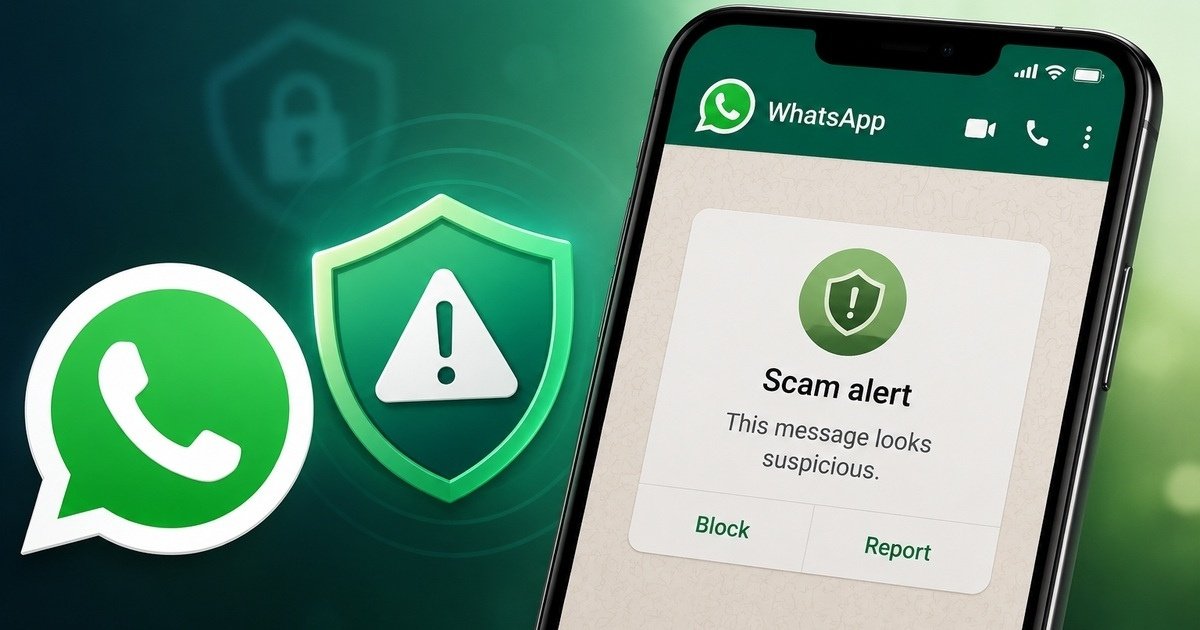
WhatsApp is testing a new security feature designed to warn users when messages from unknown contacts appear to follow common scam patterns. Called Scam Alert, the optional feature uses machine learning directly on a user’s phone to analyse certain incoming messages and identify potentially suspicious conversations.
The feature comes at a time when scammers are increasingly using messaging platforms to impersonate people, promote fake opportunities and trick victims into sharing money or sensitive information. WhatsApp says Scam Alert is intended to provide users with an additional warning before they decide whether to continue engaging with a suspicious sender.

How the New WhatsApp Scam Alert Works
When Scam Alert is turned on, WhatsApp downloads a small machine learning model onto the user’s device. The model examines incoming messages from people who are not saved in the user’s contacts and checks whether the conversation resembles patterns found in previously reported scams.
According to Meta, the system does not simply search for one suspicious word or phrase. Instead, it uses conversational structure and linguistic signals to estimate whether a message is likely to be part of a scam attempt.
If the system identifies a likely scam, WhatsApp displays a warning inside the chat. The person who sent the message will not see that warning, and the recipient can then decide whether to block the sender, report the conversation or continue chatting.
Users can also mark a conversation as trusted if they believe it has been incorrectly flagged. Once that is done, Scam Alert will stop warning the user about that particular conversation.

Does This Mean WhatsApp Will Read Your Messages?
This is likely to be one of the biggest concerns surrounding the feature because WhatsApp is built around end-to-end encryption. Meta says the scam detection takes place directly on the user’s phone, meaning message content does not have to be sent to WhatsApp or Meta for the system to decide whether it looks suspicious.
Meta also says Scam Alert does not automatically report a suspicious conversation. Even if the system believes a message is a scam, the content of that conversation is not automatically shared with WhatsApp, Meta or another third party.
There is an optional way users can contribute to improving the system. If a user marks a flagged conversation as trusted, WhatsApp may allow that person to voluntarily share the last five received messages to help improve Scam Alert’s accuracy.
Why WhatsApp Is Introducing Scam Alert
Online scammers continue to change the methods they use to approach potential victims. Their tactics can include impersonation, social engineering, fake investment opportunities, fraudulent job offers and increasingly convincing AI-generated messages.
WhatsApp has already introduced several security measures aimed at reducing messaging scams. In 2025, for example, the platform announced additional safety information for users who were added to unfamiliar groups by people they did not know, while also encouraging users to pause and verify unexpected requests before responding.
Meta introduced further anti-scam protections in 2026, including warnings designed to identify suspicious attempts to link WhatsApp accounts to other devices. Such scams can involve criminals persuading victims to share device-linking codes or scan fraudulent QR codes so that the criminals can gain access to their accounts.
Scam Alert takes a different approach by examining suspicious message patterns directly on the user’s device. Instead of waiting until a user reports a conversation, the system is designed to warn the recipient while the conversation is taking place.
What Kind of Messages Could Trigger a Warning?
Meta has not provided a simple public list of words or phrases that automatically trigger Scam Alert. The company says the model instead looks at conversational structure and linguistic signals associated with scam conversations previously reported by WhatsApp users.
This means users should not expect every message containing words such as “money,” “job” or “investment” to be automatically labelled as a scam. The system makes a probability-based assessment of the overall message pattern rather than relying on a single keyword.
Users should nevertheless remain cautious when unexpected messages promise unusually high investment returns, offer unrealistic employment opportunities, demand urgent payments or request passwords, PINs and verification codes. Scam Alert can provide an additional warning, but users will still need to apply their own judgement when communicating with unknown contacts.
Will WhatsApp Scam Alert Be Available in Ghana?
For now, WhatsApp has not announced a specific date when Scam Alert will become generally available to users in Ghana. Meta said on August 12, 2026 that the feature had begun a limited beta rollout and would continue to be tested before being made available more widely.
This means Ghanaian users should not assume that something is wrong with their WhatsApp if Scam Alert is not currently available on their phones. Updating to the latest version of WhatsApp may also not immediately provide access while Meta continues the limited rollout.
WhatsApp has also not published a complete timetable showing when each country will receive the feature. Users may therefore receive Scam Alert at different times as the company expands testing and eventually moves towards wider availability.
What About Your Privacy?
Meta says Scam Alert was specifically designed so that the machine learning model and the message data it processes remain on the user’s device. The company says WhatsApp receives only privacy-protected aggregate information needed to understand how frequently warnings are shown and what general actions users take after receiving them.
According to Meta’s technical explanation, those aggregate statistics do not contain message content or information identifying individual conversations. The company also says security researchers will be able to examine aspects of the system, including published model information and transparency mechanisms, to verify how the technology operates.
Users will also have control over whether Scam Alert is enabled. Meta says the feature is optional and can be turned on or off by the user rather than being permanently forced on every WhatsApp account.
What You Should Do Until Scam Alert Reaches You
WhatsApp users should continue treating unexpected messages with caution, especially when the sender is requesting money, offering an unusually profitable opportunity or creating pressure for an immediate response. A convincing profile picture, familiar name or professional-looking message should not be treated as proof that the person is genuine.
WhatsApp has previously encouraged users to pause, question suspicious requests and verify the identity of anyone making an unusual demand. If someone claiming to be a friend, relative, employer or organisation suddenly asks for money or sensitive information, verify the request through another trusted method before taking action.
Users should also avoid sharing WhatsApp verification codes, passwords, mobile money PINs or other sensitive financial information with anyone through a chat. Scam Alert may eventually make suspicious conversations easier to identify, but no automated security system can guarantee that every scam attempt will be detected.
Final Note
WhatsApp’s new Scam Alert could become a useful additional defence against the growing number of scams that begin with an innocent-looking message from an unknown number. Its most notable feature is that Meta says the detection happens directly on the user’s device rather than sending private message content to company servers for classification.
For now, however, Scam Alert remains in limited beta and there is no confirmed date for general availability in Ghana. Until it becomes widely available, the strongest protection is still to verify unexpected requests, avoid rushing into financial decisions and think carefully before sharing sensitive information with anyone through WhatsApp.
You May Have Missed