
Should Artificial Intelligence Be Allowed in Our Schools? From Basic Education to Universities.
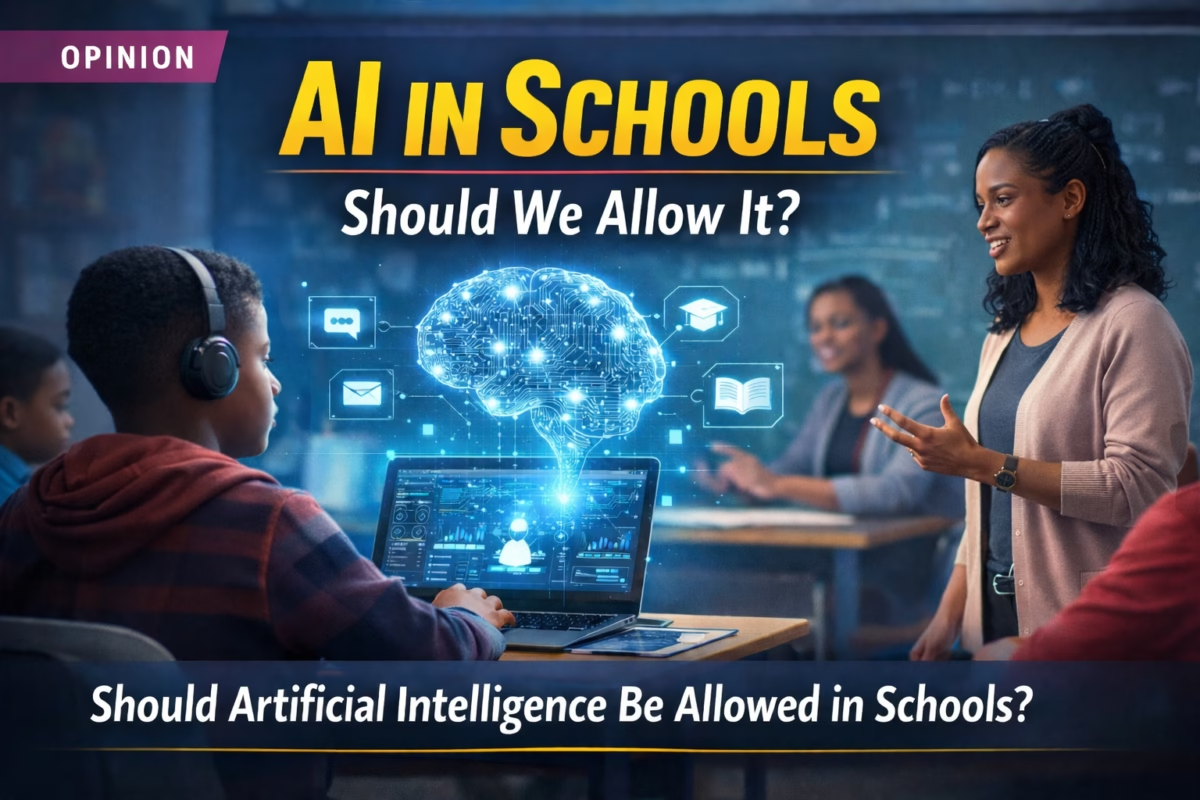
Artificial Intelligence is rapidly reshaping how people access knowledge, solve problems, and learn new skills. Tools such as ChatGPT and Google Gemini can now explain complex concepts, summarize textbooks, generate study materials, and assist with research in seconds.
As these technologies become more widespread, educators around the world are grappling with an important question: Should artificial intelligence be allowed in our schools? From basic education to universities.

Recently, this question surfaced during a graduate-level Business Information Systems lecture I attended. What began as a simple classroom prompt quickly developed into a lively debate that reflected the broader global conversation about AI in education.
A Debate from the Graduate Classroom
During the lecture, the class was asked whether artificial intelligence should be allowed in schools. The responses revealed sharply different viewpoints.
Some participants argued that AI should not be allowed at all. Their concern was that such tools could encourage academic dishonesty and make students overly dependent on technology rather than developing their own thinking skills.
Others took the opposite view. They argued that AI should be freely allowed, pointing out that students already have access to these tools outside the classroom. From this perspective, trying to ban AI in schools would simply ignore the reality of the digital world students live in.
A third group suggested a more balanced approach: AI could be allowed, but students should acknowledge when they use it, much like citing books or academic sources in assignments.
In contributing to the discussion, I argued that artificial intelligence should indeed be allowed in schools but with clear policies and responsible guidelines. Attempting to ban the technology entirely may not be practical. More importantly, students and educators who completely reject these technologies may risk being left behind in the years ahead.
The machines are coming, whether we are ready or not. The real challenge is preparing education systems to use them wisely.
A Lesson from the Past
Reflecting on the debate, I was reminded that society has often reacted cautiously to new technologies.
In the early days of television, some Christian leaders expressed concern about the potential influence of TV on moral and spiritual life. Over time, however, many churches and ministries began using television themselves to broadcast sermons and reach wider audiences. Today, religious programming is common on television and online platforms.
This historical shift illustrates a broader pattern: technologies that are initially viewed with suspicion can later become valuable tools when used responsibly.
Artificial intelligence may now be at a similar stage in education.
Why Some Educators Support AI in Schools
Supporters of AI in education argue that the technology can significantly improve learning experiences.
One key benefit is personalized learning. AI systems can adapt explanations to individual students’ needs and learning pace. For example, the nonprofit Khan Academy has developed an AI-powered learning assistant called Khanmigo, designed to guide students through problems step by step rather than simply giving answers.
This approach encourages students to think critically while still benefiting from AI-assisted support.
AI can also help teachers. Educators often spend many hours preparing lesson materials, quizzes, and teaching aids. AI tools can assist with generating practice questions, organizing content, and simplifying complex concepts, allowing teachers to spend more time focusing on actual teaching and mentoring.
According to guidance from UNESCO, artificial intelligence has the potential to support more inclusive and personalized learning if implemented responsibly (UNESCO, 2023).
The Concerns That Cannot Be Ignored
Despite these benefits, concerns about AI in education remain valid.
One of the biggest fears is academic dishonesty. Because AI tools can generate essays and answers quickly, some students may be tempted to submit AI-generated work as their own.
This issue has already surfaced in several universities around the world. Reports from the United Kingdom indicate that thousands of students have been investigated for improper use of AI tools in academic work (The Guardian, 2025).
Another concern is over dependence on technology. Education is not just about finding answers; it is about developing skills such as critical thinking, creativity, and problem-solving. If students rely too heavily on AI systems, they may struggle to build these abilities independently.
There is also the issue of digital inequality. Many AI tools require reliable internet access and digital devices. In regions where such infrastructure is limited, students without access to technology may be disadvantaged if AI becomes central to learning.
How Schools Might Respond
Given both the opportunities and risks, many experts believe the best approach is not to ban AI entirely but to regulate its use carefully.
Schools could adopt policies that would allow schools to benefit from AI while protecting academic integrity. These measures would:
- Require students to acknowledge AI assistance in assignments
- Teach students about ethical and responsible AI use
- Redesign assessments to emphasize understanding and critical thinking
- Train teachers to integrate AI tools effectively in the classroom
Final Thoughts
Artificial Intelligence is already transforming the way people learn and work. The question is no longer whether AI will enter our classrooms; it already has.
The real question is how education systems will respond.
From my perspective, rejecting AI entirely may only delay the inevitable. Instead, schools should focus on preparing students to use these tools responsibly and intelligently.
History shows that societies often move from suspicion to adaptation when confronting new technologies. Artificial intelligence may follow the same path.
The machines are coming. The task before educators is not to resist them blindly, but to ensure they serve learning rather than replace it.
What do you think?
Should artificial intelligence be allowed in schools, or should its use be restricted?
You May Have Missed





Yes but not for basic schools
“AI is useful for humans, but when it is overused, it can make the human mind dull because people may stop thinking deeply or solving problems on their own.